Author: Mr Oliver Eaton BSc (Hons), PG.Cert – Orthopaedic Specialist
Reviewed by: Mr William Sharples BSc (Hons) – Pain Management Expert
Last Updated: September 2025
In this article, you will learn everything you need to know about pulled elbows and the most effective ways to treat them, including an advanced treatment called Prolotherapy.
Table of Contents
- Causes of Pulled Elbow
- Symptoms of Pulled Elbow
- Diagnosis
- Treatment
- Prolotherapy
- Frequently Asked Questions
- Case Studies
- Clinic Information
- Author Bio
- References
Pulled elbow, also referred to as the Nursemaid’s elbow, is a frequently encountered condition in young children’s joints characterized by the partial dislocation of the radius bone of the elbow joint. This common injury occurs when the radial head slides under the annular ligament, causing pain, particularly in a supine position of the forearm. It is common in young children as their ligaments and joints are still growing and do not require a lot of force to get pulled out of place. (1) (2)
Causes of Pulled Elbow
Pulled elbow is most commonly caused by a sudden pull of the arm, particularly when it is extended. A common instance is when the child’s arm is lifted or swinging. The elbow injuries caused by such movement can cause the slippage of the annular ligament, which further leads to the ligament being stuck between the humerus and radius. (3)
Symptoms of Pulled Elbow
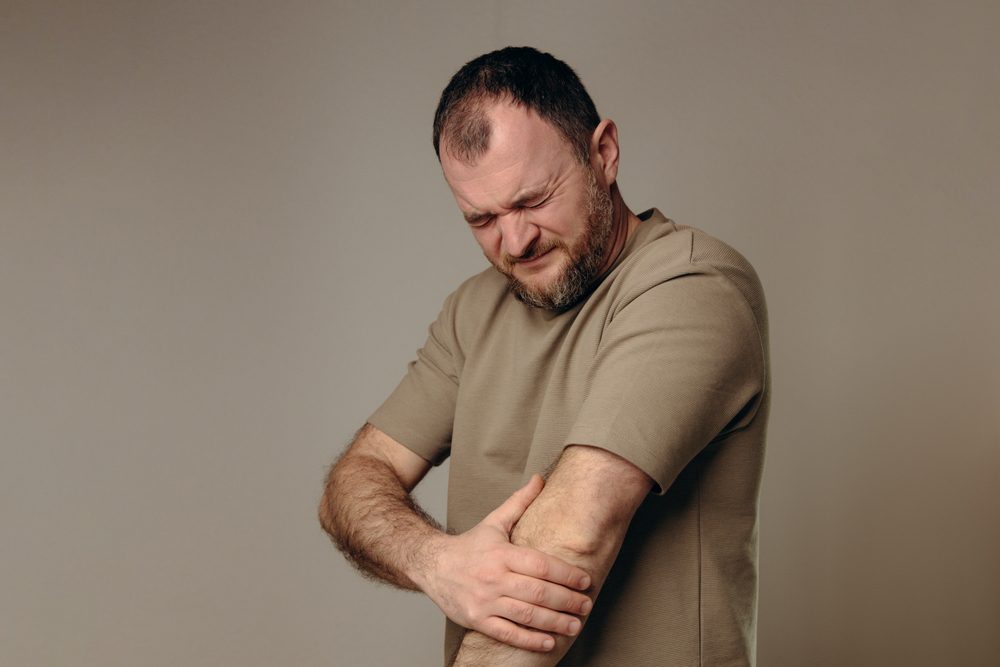
Children with a pulled arm often have a history of their arm being pulled from its normal position by the wrist by a caregiver. Symptoms usually start when the child falls onto their outstretched arm. The child often holds their injured arm in a protective way, with the injured arm in complete extension or pronation, refusing to move it due to pain. Tenderness over the radial head may prevent pronation, supination, and flexion. There is often no redness, ecchymosis, or edema.
Diagnosis of Pulled Elbow
The paediatric or healthcare physician inspects the injured arm and clavicle, examining for tenderness. Pulled elbow is often diagnosed clinically without imaging. X-rays are reserved for suspected trauma, dislocation, fracture, or abuse. Physicians should also consider simultaneous injuries such as pulled muscle chest symptoms.
Treatment for Pulled Elbow
The most common treatment is closed reduction, typically conducted within seconds. Pain usually resolves immediately after reduction. Painkillers like paracetamol or ibuprofen may be recommended. Two main reduction methods exist:
Hyper pronation method
The doctor supports the child’s elbow while applying moderate pressure on the radial head. The forearm is hyperpronated, and a click indicates successful reduction. This method is often less painful and more successful for first-time cases.
Supination and flexion method
The doctor applies light pressure to the radial head while fully supinating and flexing the forearm. A click indicates success. This method is often a second option if hyper pronation fails. (10)
Prolotherapy
Prolotherapy has built a strong reputation for treating pulled elbows with clinically proven pain-relieving, anti-inflammatory, and regenerative benefits. It involves injecting a natural regenerative solution with tiny needles to stimulate collagen production, repairing the damage and addressing the root cause. Prolotherapy may offer a permanent solution, preventing recurrence.

Disclaimer: The information provided in this section is for educational purposes only and is not a substitute for professional medical advice, diagnosis, or treatment. Prolotherapy may not be suitable for everyone, and outcomes can vary. Always seek the guidance of a qualified healthcare professional regarding your specific medical condition or treatment options. Never disregard professional medical advice or delay seeking it because of information you have read here.
Frequently Asked Questions
How long does it take for a pulled elbow to heal?
Healing may take up to four weeks, sometimes aided by physical therapy for stretching and strengthening.
Can you see pulled elbow on the x-ray?
A pulled elbow is often not evident on an x-ray unless associated with trauma.
Can a pulled elbow correct itself?
Occasionally, yes, but consultation with a healthcare provider is recommended. Long-term issues are rare.
What does a strained elbow feel like?
Swelling, tenderness, and pain during movement; pain may persist at rest.
Can you pull your elbow out of the socket?
Dislocation occurs when one of the elbow bones is forced out of place, causing immediate pain and immobility.
Case Studies
Case Study 1: A 3-year-old child presented with a sudden refusal to move the left arm after being lifted by the wrist. Hyper pronation reduction successfully relieved pain within seconds. Follow-up at two weeks showed full recovery.
Case Study 2: A 4-year-old patient suffered a pulled elbow during playground activity. Supination and flexion reduction method was used, and prolotherapy injections were applied due to recurrent ligament laxity. Patient remained symptom-free at 3-month follow-up.
Contact ProHealth Clinic Today for Your FREE 15-Minute Discovery Call
Don’t let Pulled elbow control your life any longer. Join the thousands of patients who have found lasting relief through prolotherapy at ProHealth Clinic.
Get in Touch
Phone: +441234380345
Email: info@prohealthclinic.co.uk
Our Clinic Locations
London: 104 Harley Street, Marylebone, W1G 7JD
Manchester: The Hadley Clinic, 64 Bridge Street, M3 3BN
Bedford: The Village Medical Centre, Kingswood Way, MK40 4GH
All clinics offer the same award-winning prolotherapy treatment with convenient appointment times, including evenings and weekends.
Author Bio
Having performed over 10,000 procedures, Mr Eaton is one of the UK’s leading practitioners in the field of treating Pulled elbow, with patients travelling to see him from across the UK, Europe, and the Middle East.
With over 12 years of clinical experience, Oliver is dedicated to helping patients understand their symptoms associated with Pulled elbow and providing effective treatment options to alleviate them.
He qualified in Prolozone Therapy and Prolotherapy in America with the American Academy of Ozonotherapy. He continued further qualifications at the Royal Society of Medicine, Charing Cross Hospital in London, Keele University’s Anatomy & Surgical Training Centre, and Heidelberg University in Germany.
Over the years he has treated many elite-level athletes, including Olympic and Commonwealth medallists.
Mr Eaton’s expertise has been featured in many national news and media publications, including The Telegraph, The Daily Mail, The Daily Express, Women’s Health Magazine, and The Scotsman.
Linkedin profile: https://www.linkedin.com/in/oliver-eaton-4338225b/
References
- Mohd Miswan, M. F., et al. (2017). Pulled/Nursemaid’s elbow. Malaysian family physician, 12(1), 26–28.
- Wong, K., et al. (2016). Radial Head Subluxation: Factors Associated with Its Recurrence and Radiographic Evaluation. J Emerg Med, 51(6), 621–627. https://doi.org/10.1016/j.jemermed.2016.07.081
- Nardi NM, Schaefer TJ. Nursemaid Elbow. StatPearls, 2022. https://www.ncbi.nlm.nih.gov/books/NBK430777/
- Chen, H., et al. (2019). Replacement or repair of terrible triad of the elbow: A systematic review and meta-analysis. Medicine, 98(6), e13054. https://doi.org/10.1097/MD.0000000000013054
- Wang, Q., et al. (2019). External Fixator-assisted Ulnar Osteotomy: A Novel Technique. Orthop Surg, 11(1), 102–108. https://doi.org/10.1111/os.12426
- Cope, B., & Tracy, M. (2018). Not just another nursemaid’s: an enigmatic paediatric humeral fracture. BMJ Case Reports, 2018, bcr2017222925. https://doi.org/10.1136/bcr-2017-222925
- Pawelec, B., et al. (2018). Neglected Iatrogenic Elbow Joint Dislocation. Ortopedia, traumatologia, rehabilitacja, 20(1), 57–63. https://doi.org/10.5604/01.3001.0011.5877
- Galbiatti, J. A., et al. (2018). Terrible triad of the elbow: evaluation of surgical treatment. Rev Bras Ortop, 53(4), 460–466. https://doi.org/10.1016/j.rboe.2018.05.012
- Krul, M., et al. (2017). Manipulative interventions for reducing pulled elbow in young children. Cochrane Database Syst Rev, 7(7), CD007759. https://doi.org/10.1002/14651858.CD007759.pub4
- Ulici A, et al. (2019). Nursemaid’s Elbow – Supination-flexion vs Hyperpronation: Indian J Orthop, 53(1), 117-121. doi: 10.4103/ortho.IJOrtho_442_17. PMID: 30905991; PMCID: PMC6394198.
Disclaimer: This article is for informational purposes only and does not substitute for professional medical advice. Always consult your healthcare provider before making treatment decisions.